

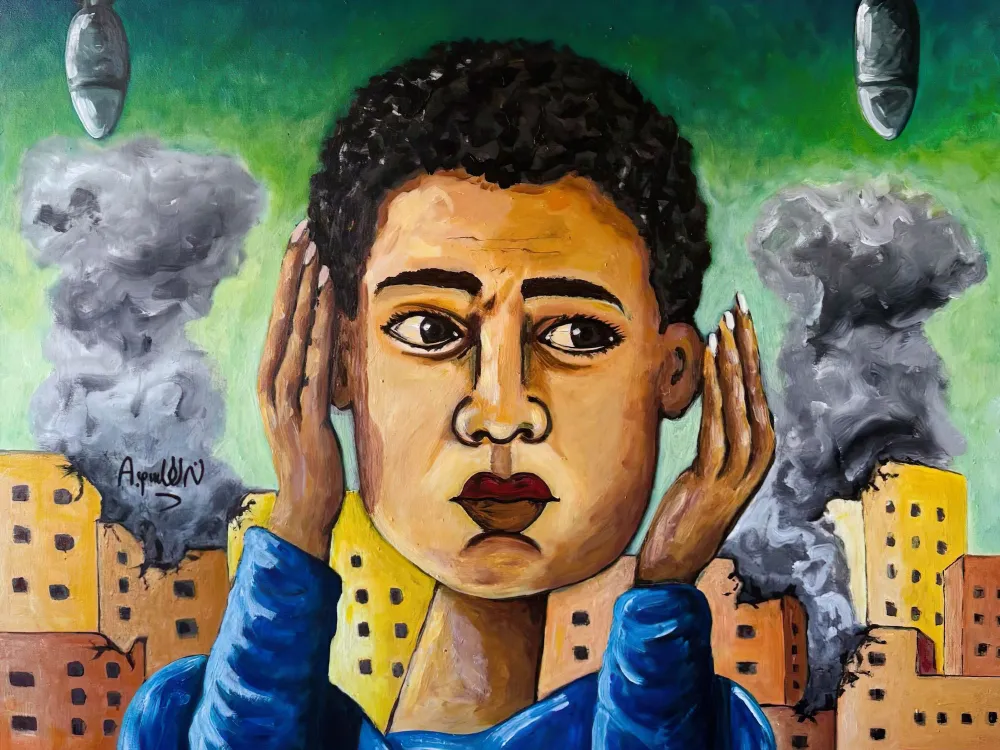
By its own ambitions, the Gaza Biennial is not just a group exhibition, but a tremendous cry for humanity. The intact heart will hear it and appreciate the gallery attendant’s gentle warning that tissue boxes are available for use.
The full version of this roving biennial was on view at the Brooklyn nonprofit art space Recess through this past Sunday, though it remains on view in an abbreviated version from September 18 until December 20. It features the work of 25 artists from Gaza, most of whom remain in the besieged strip.
Their perspectives on nearly two years of carnage have been poured into painting, video installation, drawing, and oral and written testimony. The exhibition is hosted in an alternative space, not a mainstream museum notable, given that New York institutions such as the Whitney have faced allegations of anti-Palestine censorship. There will likely be no greater show of consequence in the city during its run.
The Gaza Biennale was conceived in April 2024 in Palestine by Gazan artists and developed throughout the war in collaboration with the Forbidden Museum of Jabal Al Risan. Prior to arriving in Brooklyn, the biennial was staged in 17 pavilions or jinnahs, meaning branches or wings worldwide, reflecting the diasporic reality of Palestinians post Israeli occupation. The biennial was unable to be hosted in Gaza, so its model, the biennial has said, is itself “displaced,” just like Gazans. Artworks are not to be considered reproductions but presented ex situ, or ripped from their natural setting. Created in rubble, under fire, and in improvised tents, they are testaments to the mundane miracle of survival.
Visitors to Recess will have ample opportunity to hear from the artists too. Alongside printed transcripts of artists’ interviews, most wall texts include messages from these creators musing on their practice and its context. In the short film Live Broadcast (2025), the journalist Emad Badwan chronicles the daily struggles of reporters in Gaza, from the search for an internet connection, to the queues for basic necessities which may or may not materialize, all while anticipating the next drone strike. This year the Watson Institute for International and Public Affairs’ Costs of War project reported that at least 220 journalists have been killed in Gaza in less than two years, more than in conflicts waged in Vietnam, Yugoslavia, and Afghanistan, as well as the two World Wars, combined. Most of Badwan’s film has no effective climax his neighbors wait in line for a working bathroom, and sit by rubble as ad hoc salesmen call out cigarettes for sale but the dreadful context carries each still to historic importance.

“I choose to tell the story of how a person is not a number,” says the painter Aya Juha, from a screen near Live Broadcast that plays interviews with biennial participants. “The war resulted in a huge number of martyrs, a huge number of prisoners, a huge number of injuries. The world outside treats these horrors as numbers.”
It would take determined ignorance to mistake the figuration rich collection of artworks on view for numbers, even those that feature only the suggestion of hands and hearts. Take Ghanem Alden’s video installation The Rocket and the Carrot (2025): A satire of the diplomatic approach favored by colonial powers in which threat and reward are simultaneously incentivized. In the gallery, carrots dangle above a symbolic refugee camp. Photographs of paltry meals and necessities gathered by Gazans are displayed on the adjacent wall. Alden likens the carrots to the humanitarian aid some 2,400 Gazans have died trying to collect. Visitors were invited to take the show home, via gift bag of vegetables. The generosity this gesture is a matter of interpretation.
This is a compliment: the total, devastating effect of this presentation is still a poor simulation for the reality of Gaza, given the reported rate of its annihilation (the media blackout persists, as do Gaza’s journalists). This month, the Government Media Office in Gaza condemned in a statement as Israel’s “systematic bombing” of civilian structures, with “extermination and forced displacement” as the aim. According to the Palestinian Ministry of Health, nearly 65,000 Palestinians and injured more than 164,000 have been killed since October 7, 2023.

Diaries accompany some of these artworks, incalculably precious. Knowledge is a terrible duty, and New York must learn how internationally and regionally renowned artists now sacrifice and scrounge for pens, paints, canvas, paper. ‘Can art enact change in the world?’ The Gaza Biennial is a testament to the insult of that vantage point: Rather than place the onus on artists to impress empathy into the West, ask why the West needs photographs, drawings, and films of bleeding children to enact change. And what better attests to the salvation of art than the fact artists in Gaza still create?
Taking shelter in a garage turned studio, Osama Husein Al Naqqa re-created scenes of the dead and living in Gaza as digital drawings on his phone, using his finger as his pencil. “During displacement and ethnic cleansing, your ID card becomes a decisive factor it can mean safe passage, detention, or death,” he writes below Life or Death Card (2024).
Nearby is Suhail Salem’s original bound notebook, transported here under the name A Call for Help (2025). A faculty member in the art department at Al Aquar University, he has filled the pages with expressionistic ink drawings of the people and rubble he sees and dreams. “It was the most brutal when I was forced to walk over the bodies of martyrs during the displacement … My sketches were quick, chaotic, with no room for calm.”
Salem concludes: “I believe that an artwork is created in its circumstances, and it’s more than just distributing color and empty spaces. It’s a collection of emotions that I express in miniature form about my condition, my aspirations, my pain, and my hopes.”