

Some artists build a body of work around a single, well-defined idea. Natalie Angel does something different. She works from feeling outward, letting an emotion, a memory, or an unresolved thought take the lead, and trusting the imagery to arrive on its own terms. Ask her how a painting begins, and the honest answer is: she doesn’t entirely know until it’s underway.
That intuitive process sits at the center of everything Angel makes. She describes herself as an avant-garde contemporary artist working through themes of identity, transformation, freedom, and resilience, but the paintings themselves are less concerned with illustrating those ideas than with living inside them. Each canvas becomes a kind of visual diary entry, written in a language more honest than words: color, gesture, symbol.
An Artist Who Trusts the Unfinished Thought
Angel is candid about what draws her to painting in the first place the things she can’t quite say out loud. Feelings without names. Memories that resurface uninvited. The quiet, invisible threads connecting one person’s experience to another’s. Rather than trying to translate these into tidy statements, she lets them surface as images, trusting that a viewer might recognize something of their own in the result.
This is art as processing rather than performance. Angel has spoken of painting as a way of transforming emotion into something meaningful, not resolving it, necessarily, but giving it shape. It’s a generous way of working, one that leaves room for the viewer to bring their own story to the canvas rather than being told what to feel.
Three recent paintings, each dated 2026, show this philosophy taking distinctly different forms.
“Trojan Horse”: Recognizing Danger in Disguise
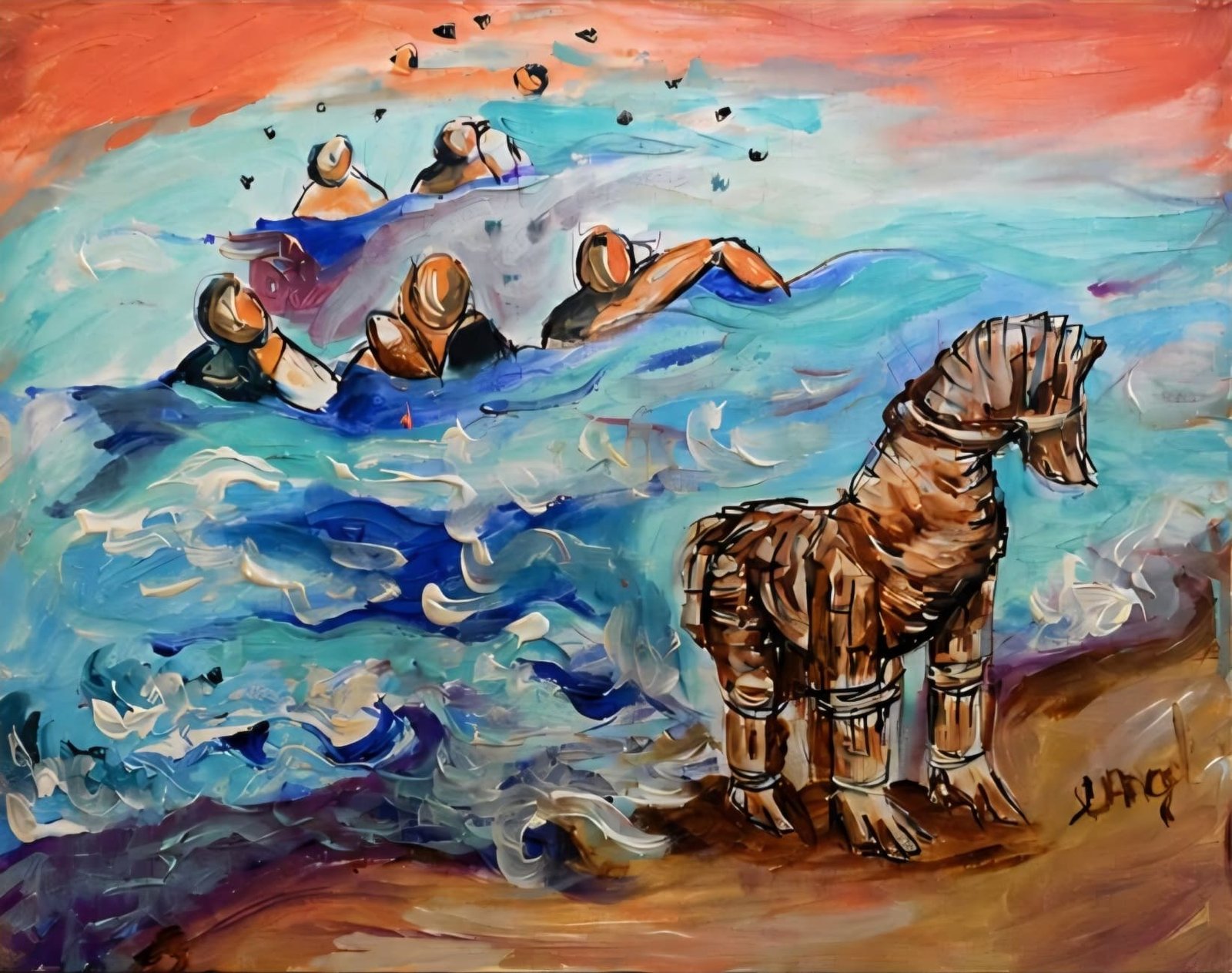
The first, “Trojan Horse,” rendered in acrylic on canvas, takes its cue from one of history’s oldest cautionary images the gift that conceals an attack. But Angel isn’t interested in retelling the myth. She’s interested in what it teaches about the present. As she puts it, the Trojan Horse never really disappeared; it simply changed shape. Appearances deceive, she suggests, and vigilance is the cost of protecting what matters.
It’s a deliberately open piece; she doesn’t point to a specific historical or political target, and the painting is stronger for it. Instead, “Trojan Horse” functions as a kind of visual warning system, asking viewers to consider how easily threat can be mistaken for safety, and how much attention it takes to tell the difference.
“Faith and Fire”: A Different Kind of Burning
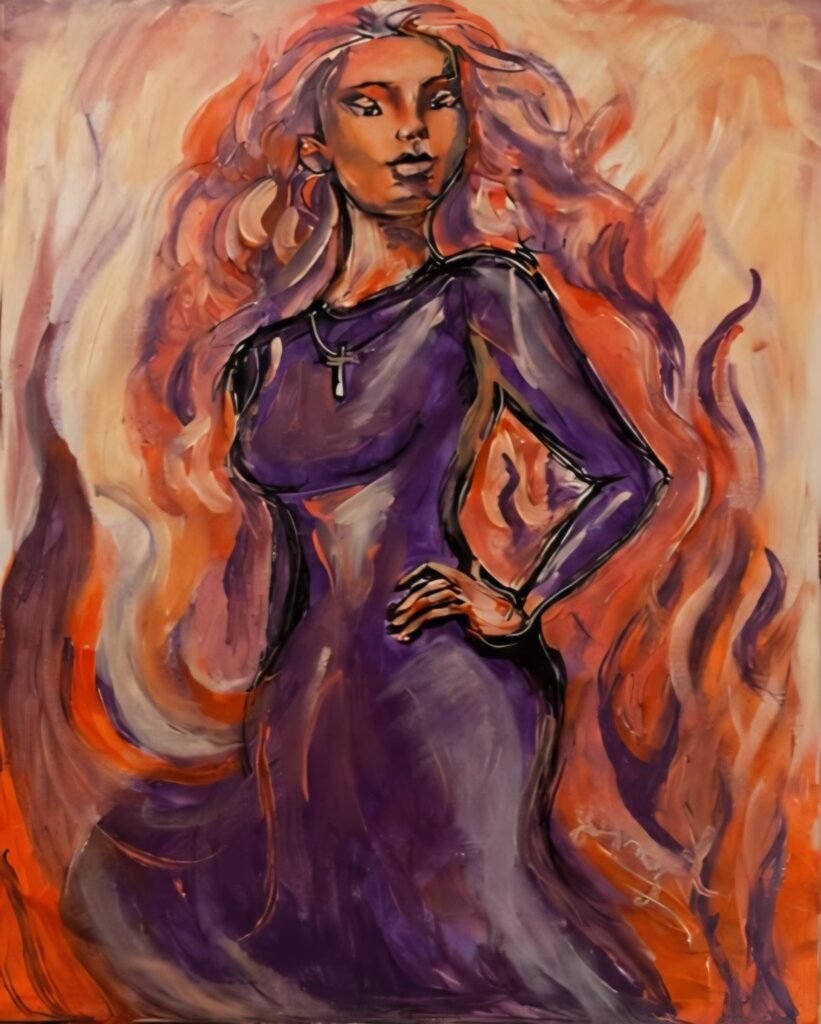
Where “Trojan Horse” looks outward at deception, “Faith and Fire” turns the lens inward. The acrylic painting carries one of Angel’s most striking lines: not every flame destroys; some reveal the woman you were always meant to become. It’s an idea that flips the usual meaning of fire on its head. Instead of loss, Angel paints arrival.
This isn’t a simple stand-in for passion, and Angel is careful not to let it read that way. The fire in this painting functions more like a rite of passage, something that changes a person by moving through them, leaving behind not ash but clarity. It’s one of the clearest expressions in her current body of work of a recurring idea: that transformation, however difficult, can also be a form of homecoming to a truer self.
“Between Earth and Elsewhere”: Choosing Wonder Over Fear
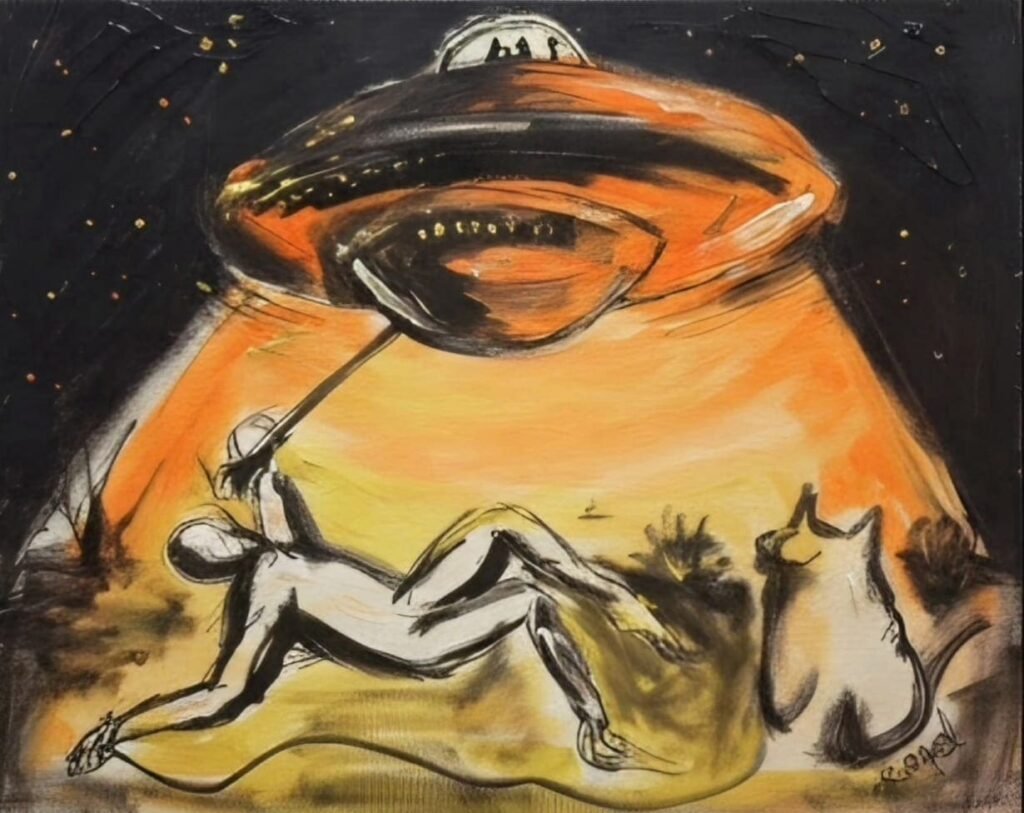
The third painting asks its viewer to sit with uncertainty rather than resolve it. In “Between Earth and Elsewhere,” a mysterious presence descends from the sky. A small dog watches without alarm. A human figure stands grounded, neither retreating nor reaching out. The scene is quiet, almost suspended.
Angel poses a direct question through the work: what if the unknown isn’t here to take something from us, but to awaken our curiosity? It’s a small but meaningful shift in perspective, treating the unfamiliar as an invitation rather than a threat. The painting sits at the boundary between imagination and reality, fear and fascination, and suggests that some of life’s most important discoveries happen the moment someone chooses curiosity over the safety of certainty.
Seen alongside “Trojan Horse” and “Faith and Fire,” this piece rounds out a set of paintings less about the images themselves and more about the postures they ask viewers to take alertness, courage, openness.
A Practice Still Reaching Outward
Angel is still in the process of building her presence beyond the studio. Working under the name Natalie Angel, she’s actively hoping to connect with galleries, collectors and art lovers in new markets not through claims of existing partnerships, but through the steady, patient work of putting paintings into the world and seeing who responds.
It’s a modest ambition stated plainly, and it fits the tone of the work itself: unhurried, sincere, more interested in genuine connection than self-promotion.
Where the Work Leaves You
By the time you step back from Angel’s paintings, from the disguised threat of “Trojan Horse,” to the revealing fire of “Faith and Fire,” to the unhurried wonder of “Between Earth and Elsewhere,” a pattern emerges. These are not paintings that tell you what to think. They’re paintings that ask you to notice what you already feel. And in that noticing, Angel seems to say, real change becomes possible not as a dramatic before-and-after, but as something quieter: a willingness to look at fire, or fear, or the unfamiliar, and choose to see it differently.
To explore available works or follow Natalie Angel’s emerging international practice, visit www.natalie-angel-art.nl or follow @natalieangelart.