

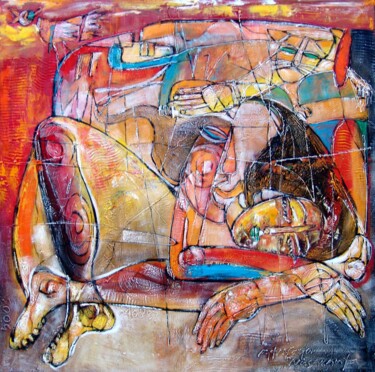
Art has the unique ability to transcend borders, cultures, and languages, creating connections between people through shared emotions and universal experiences. For Fitrajaya Nusananta, this belief lies at the heart of his artistic practice. Born in Indonesia and shaped by years of living, studying, and exhibiting across Europe and Asia, he has developed a distinctive body of work that reflects both his multicultural journey and his enduring fascination with the human psyche. Through symbolic imagery, thoughtful compositions, and open-ended narratives, Fitrajaya invites viewers to become active participants in the meaning of his paintings.
Born in 1967 in Jambi Province, Central Sumatra, Indonesia, Fitrajaya spent his childhood in Riau and West Sumatra before embarking on a life marked by frequent travel and relocation. Moving between different regions of Indonesia and later across continents exposed him to diverse cultures, traditions, and perspectives that would profoundly influence his artistic outlook. Rather than identifying with a single geographical identity, Fitrajaya embraces the role of a global artist, drawing inspiration from the richness of human experience wherever he lives and works.
His earliest artistic education came from home. Fitrajaya’s father, Sabri Jamal, an accomplished painter and graduate of ASRI Yogyakarta (1965), became his first and most influential teacher. Under his father’s guidance, he learned not only the technical foundations of painting but also the importance of observation, discipline, and creative independence. This close mentorship established the foundation for a lifelong dedication to visual art while encouraging him to develop his own artistic voice.
Seeking to expand his knowledge, Fitrajaya pursued formal studies in fine art at the University of Padang, then known as FPBS IKIP Padang. Academic training strengthened his understanding of composition, artistic theory, and visual communication while complementing the practical experience he had gained from his father. The combination of traditional mentorship and university education provided him with both technical confidence and intellectual curiosity, qualities that continue to shape his work today.
His artistic education did not end with graduation. Living in Europe, Fitrajaya continued to refine his practice through specialized art courses while immersing himself in some of the continent’s most important museums, galleries, and artistic centers. Exposure to diverse artistic movements, historical masterpieces, and contemporary exhibitions broadened his creative perspective, allowing him to engage with international ideas while remaining connected to his Indonesian roots.
Fitrajaya began exhibiting his work at an early stage in his career. His first exhibition experiences took place in Padang, where he introduced his paintings to local audiences. Even before completing his academic studies, he achieved an important milestone by holding his first solo exhibition in Jakarta, demonstrating both artistic maturity and growing recognition within Indonesia’s contemporary art scene.
Following his graduation, his career expanded internationally. Settling for periods in the Netherlands, he introduced his paintings to European audiences through numerous solo and group exhibitions. His work was later exhibited in Belgium, Spain, South Korea, and across Indonesia, reflecting a career that has consistently crossed cultural and geographical boundaries. These international experiences have reinforced his belief that art possesses a universal language capable of connecting people from different backgrounds.
At the heart of Fitrajaya Nusananta’s artistic philosophy is a profound interest in the human psyche. Rather than concentrating on specific events or individual narratives, he explores universal themes that define the shared human experience. Emotions, consciousness, identity, memory, and the complexity of personal perception become recurring subjects within his work, allowing viewers to engage with ideas that extend beyond cultural differences.
For Fitrajaya, painting is not merely a visual object but a form of communication. He believes that meaningful art emerges through the interaction between the artist and the audience. Without this dialogue, a painting remains incomplete. Viewers are not passive observers but active participants who bring their own memories, emotions, and perspectives into the interpretation of every artwork. This belief has become one of the defining principles of his creative practice.
His paintings frequently feature hybrid imagery, where recognizable forms merge with symbolic and imaginative elements. Rather than presenting straightforward narratives, these compositions encourage curiosity and reflection. Familiar shapes may appear alongside unexpected visual combinations, creating open-ended stories that resist fixed interpretation. This ambiguity is intentional, inviting every viewer to discover personal meaning within the artwork.
Fitrajaya has often expressed the idea that he does not dictate what people should see in his paintings. Instead, he offers visual fragments, symbolic clues, and narrative possibilities that allow audiences to complete the story themselves. Each viewer inevitably brings different experiences, emotions, and cultural references to the artwork, resulting in unique interpretations. In this way, every encounter with one of his paintings becomes a personal conversation between artist and observer.
This emphasis on interpretation distinguishes his work from purely decorative art. While his paintings are visually engaging, their purpose extends far beyond aesthetic appreciation. They challenge viewers to reflect, question, and participate emotionally in the creative process. For Fitrajaya, art achieves its greatest significance when it inspires dialogue rather than simply admiration.
His multicultural experiences have also contributed to the richness of his visual language. Having lived and worked across different countries, Fitrajaya has developed an appreciation for both cultural diversity and shared human values. His paintings do not belong exclusively to one tradition or artistic movement. Instead, they combine influences from Indonesian heritage, European artistic exposure, and universal psychological themes into a distinctive contemporary practice.
The symbolic nature of his work reflects his interest in the complexity of human consciousness. Rather than illustrating reality exactly as it appears, he constructs visual worlds where imagination, memory, and emotion coexist. This layered approach allows his paintings to remain relevant across cultures because they address experiences that are fundamentally human—identity, transformation, hope, uncertainty, and the search for meaning.
Throughout his career, Fitrajaya Nusananta has remained committed to creating art that encourages communication rather than certainty. His paintings invite viewers to slow down, observe carefully, and discover their own stories within each composition. Every interpretation becomes valid because it reflects the personal relationship formed between the artwork and its audience.
Today, Fitrajaya continues to contribute to the international contemporary art scene through a body of work that celebrates openness, dialogue, and emotional connection. His journey—from early artistic training in Indonesia to exhibitions across Europe and Asia—has shaped a creative vision that transcends national boundaries while remaining deeply personal. Through symbolic imagery and thoughtful visual storytelling, he reminds us that the most meaningful works of art are often those that ask questions rather than provide answers, inviting every viewer to become an essential part of the creative experience.