

Lib Mason rarely paints an idea directly. Instead, she builds a cast of stand-ins, devils, cakes, a wooden boy, a lone child in an empty field, and lets those symbols carry the weight her subjects might otherwise deliver too bluntly.
Symbolism as Strategy
Mason’s artist statement is explicit about this approach: rather than illustrating political, social, and environmental events literally, she reaches for beauty, symbolism, humor, and sometimes absurdity. That choice is technical as well as thematic. Her paintings are built using the Flemish technique, beginning with a grisaille to establish form and light, then developed through layers of transparent glaze, a slow, deliberate process that suits symbolic imagery particularly well, since it gives each element in a composition room to be considered rather than rushed past.
The Blindfolded Devils and the Seated Woman
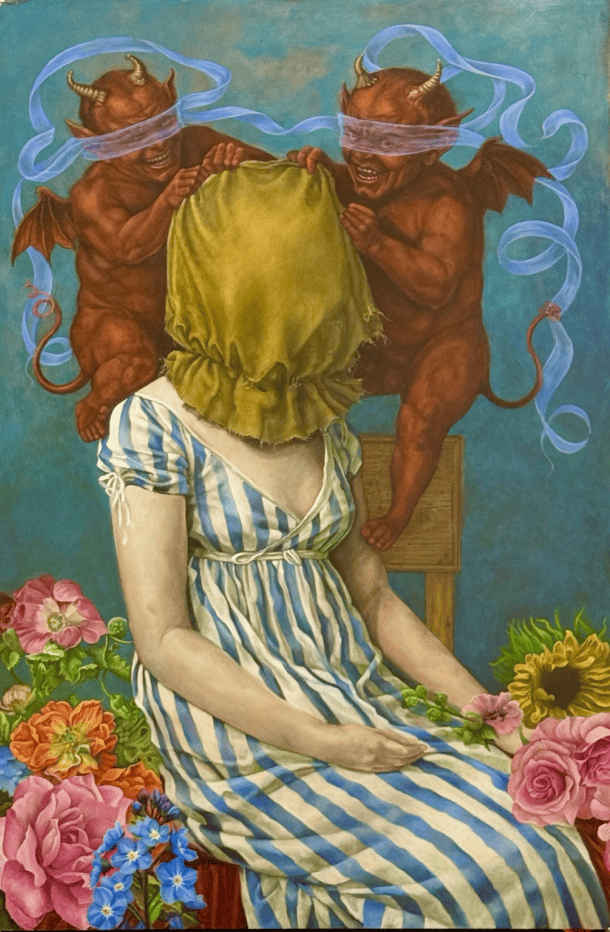
In RIP ICE, painted in response to the shooting of Renee Good, the central symbolic pairing is a set of grinning, blindfolded devils and the seated woman between them, about to have a hood pulled over her head. The devils’ grins mark them as agents of casual, almost gleeful menace, but it’s the blindfolds that carry the painting’s sharpest meaning: figures actively causing harm while visually incapable of seeing the person in front of them. Read symbolically, the blindfold becomes a stand-in for power exercised without discernment, force that doesn’t distinguish one individual from another.
That reading is reinforced by how Mason painted the woman herself. Her skin is chalky, pale, and uneven, a deliberate refusal to anchor her in a specific racial or personal identity. Symbolically, she becomes representative rather than particular, not one woman, but a placeholder for anyone who might occupy that seat. Around this scene of menace, Mason paints flowers and brilliant color, a final symbolic layer that stands for beauty and normalcy pressed uncomfortably close to violence.
Cakes, Trolls, and a Familiar Wooden Witness
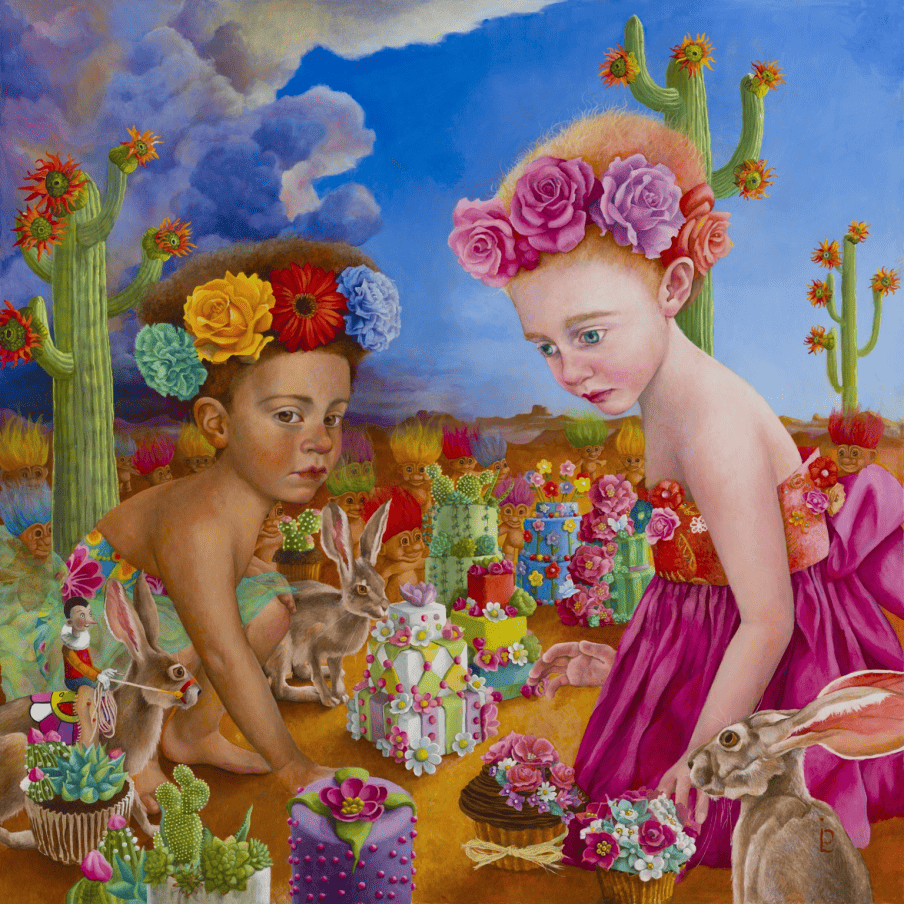
Esparza, Nadine and the Beautiful Wall builds its entire meaning through substitution. Responding to the wall constructed between Mexico and the United States, a structure Mason found both troubling and absurd, particularly for how it disrupts animal migration alongside human movement, she replaces the real wall with an invented one, built by two young girls out of cakes. The material itself is the symbol: cake, soft and celebratory, stands in stark contrast to the harshness of concrete and steel, recasting the entire concept of a dividing wall through the logic of childhood rather than policy.
The wall’s stated purpose is symbolic, too. It’s built to keep out trolls, not people, shifting the target of exclusion from a human population toward a folkloric threat, and in doing so, quietly critiques the premise of the original structure. Pinocchio’s presence in the scene adds a third symbolic layer entirely. As a character defined by his connection to lying, his role as a small witness to the girls’ wall-building gestures toward a broader idea: that in a world where truth and deception have become difficult to tell apart, even innocent constructions happen under the watch of that confusion.
The Girl in the Empty Field
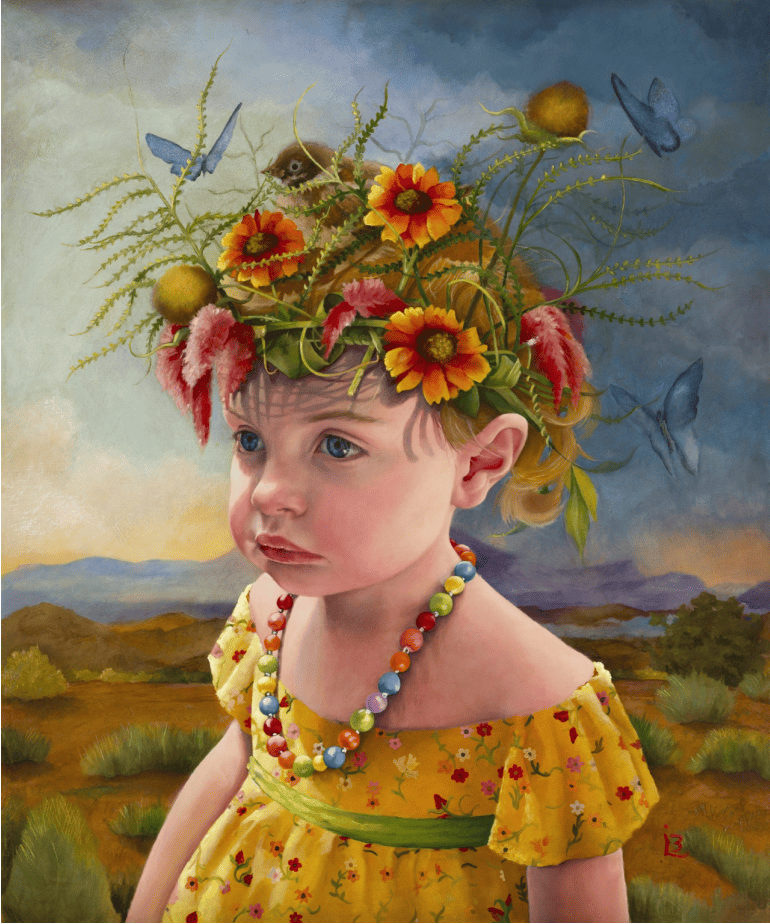
Flight relies on a sparer symbolic vocabulary. A young girl stands alone in a barren landscape; there’s no cast of secondary figures here, no invented substitute object. The girl herself carries a double symbolic role: she is both witness, observing a damaged world, and symbol, representing the generation that will inherit whatever is left of it. The barrenness of the landscape functions symbolically as well, standing in for environmental damage without depicting any of its specific causes directly. The painting’s restraint is itself part of its symbolic strategy; by refusing to overload the composition, Mason lets isolation and emptiness do the interpretive work.
Why Symbols, and Not Statements
Across all three works, Mason’s symbols share a consistent function: they let her approach difficult, sometimes painful subjects indirectly, without flattening them into simple statements. A blindfolded devil says something a literal depiction of violence couldn’t say as precisely. A wall made of cake critiques a real wall more sharply than a realistic rendering might. A single child in an empty field carries more weight than a crowded, literal climate scene could hold.
This is, in the end, what separates Mason’s paintings from illustration in the traditional sense, even though illustration is where her formal training began. Symbols, deployed carefully and built up slowly through glaze after glaze, don’t just represent an idea. They give a viewer room to arrive at that idea on their own terms, which may be exactly the kind of engagement Mason is after.
To explore more of Lib Mason’s visual metaphors and original oil paintings, visit libmasonartist.com. Follow @libmason5687on Instagram for an inside look at her studio process and latest works.