

James Day has now been an artist for twenty-five years, long enough that his own career offers a useful case study in how a practice can change shape without losing its underlying identity. Looking back across that span, from the summer of 2001 to the present, the shifts in his work are considerable, yet something recognisably consistent runs beneath all of them.
Colour Gives Way to Precision
The paintings Day made at the start of his career were bright and unguarded, full of colour and immediacy. The work he makes now could hardly be more different in technique: photorealistic, carefully controlled, and shaped by a mature form of surrealism that took years to develop. It would be easy to describe this as artistic growth in the simplest sense, skill accumulating over time, but it also reflects something more particular: an artist becoming more interested in precision as a way of making the strange feel plausible.
A Long Attachment to the Islamic World
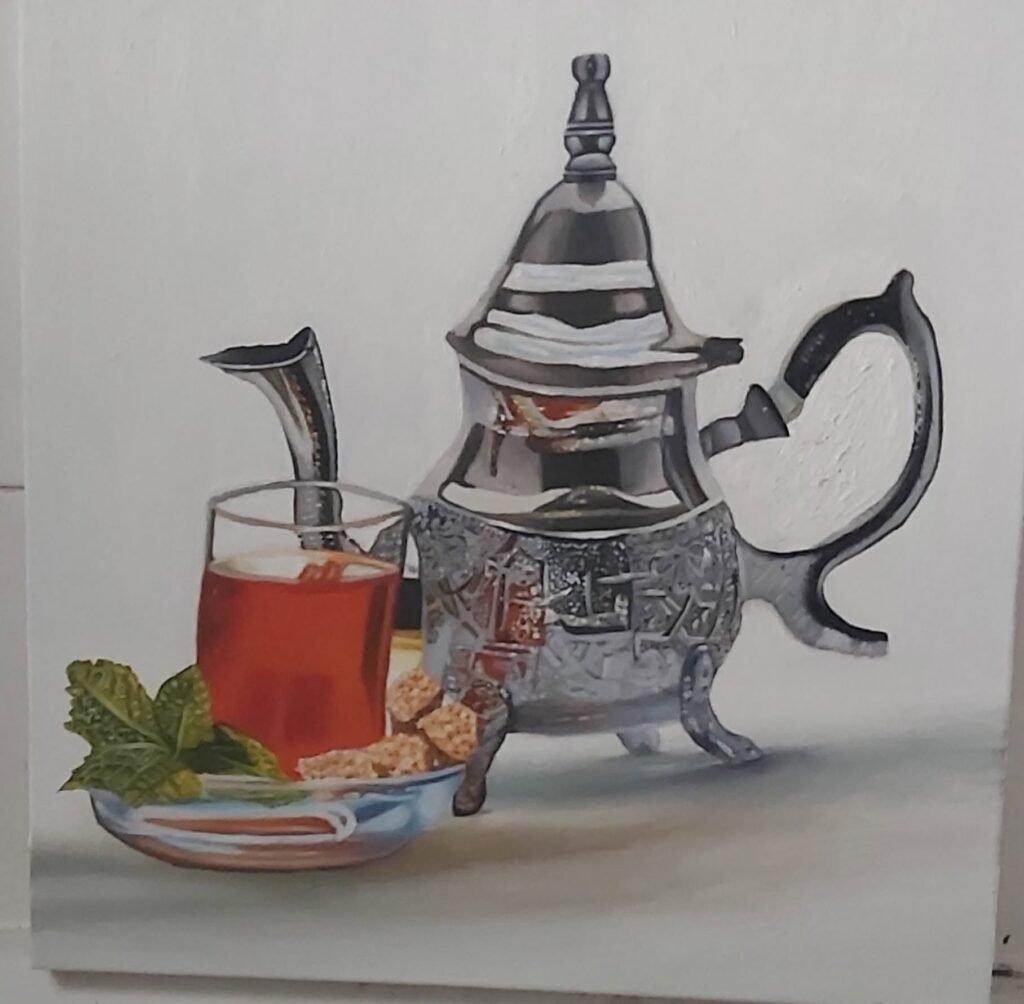
One of the more consistent threads in Day’s output is his interest in the Islamic world, present from his earliest bright architectural drawings in the 2000s through the cartoons he made in the 2010s. That interest resurfaces, transformed by his later technique, in I Like Mint Tea, a photorealistic still life of a glass of mint tea and an ornate Islamic teapot, painted in the 2020s. Day intended the work to leave the viewer with a sense of refreshment, and the painting’s technical clarity, so different from the loose energy of his early drawings, gives that intention real force.
Dalí and the Shape of Beauty
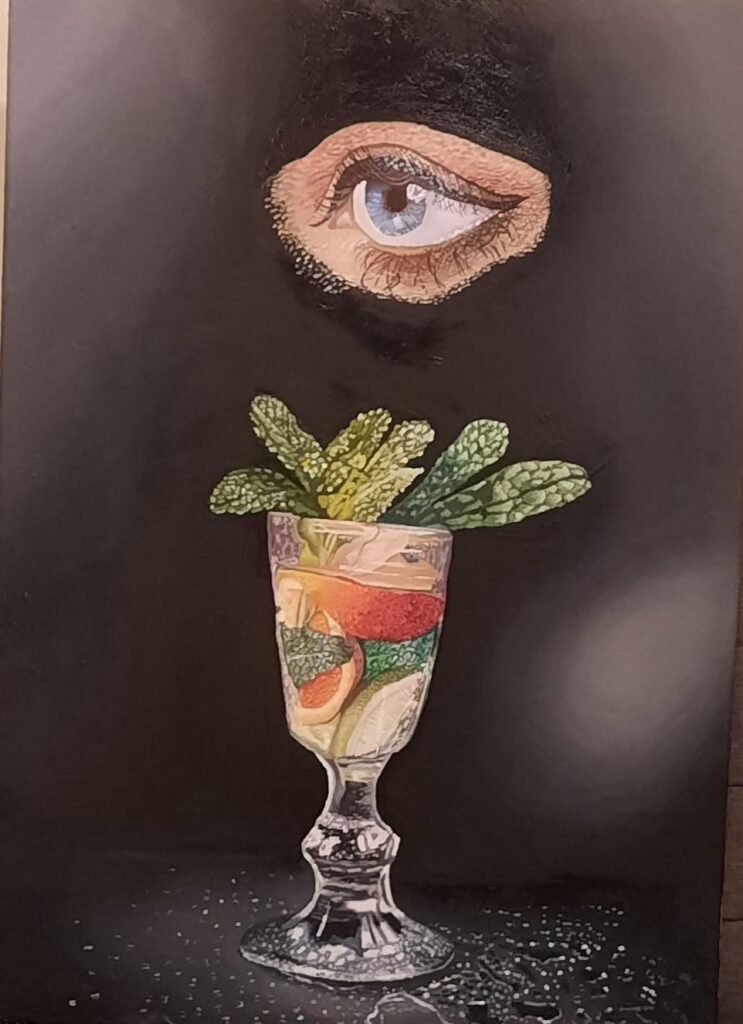
Day’s engagement with Salvador Dalí and the Surrealists began decades earlier, in his school years during the 1980s, well before it found full expression in his own painting. That early admiration, particularly for Dalí’s contribution to the dream sequence in Alfred Hitchcock’s Spellbound, eventually surfaces in Beauty Is in the Eye of the Beholder, which pairs an eye with a glass of fruit cocktail. The painting proposes, without insisting, that beauty is not confined to a single form, and that the ordinary and the symbolic can hold equal claim to it. It is a philosophically modest idea, handled with restraint rather than grand declaration.
Gravity, Newton and Standing on the Shoulders of Giants
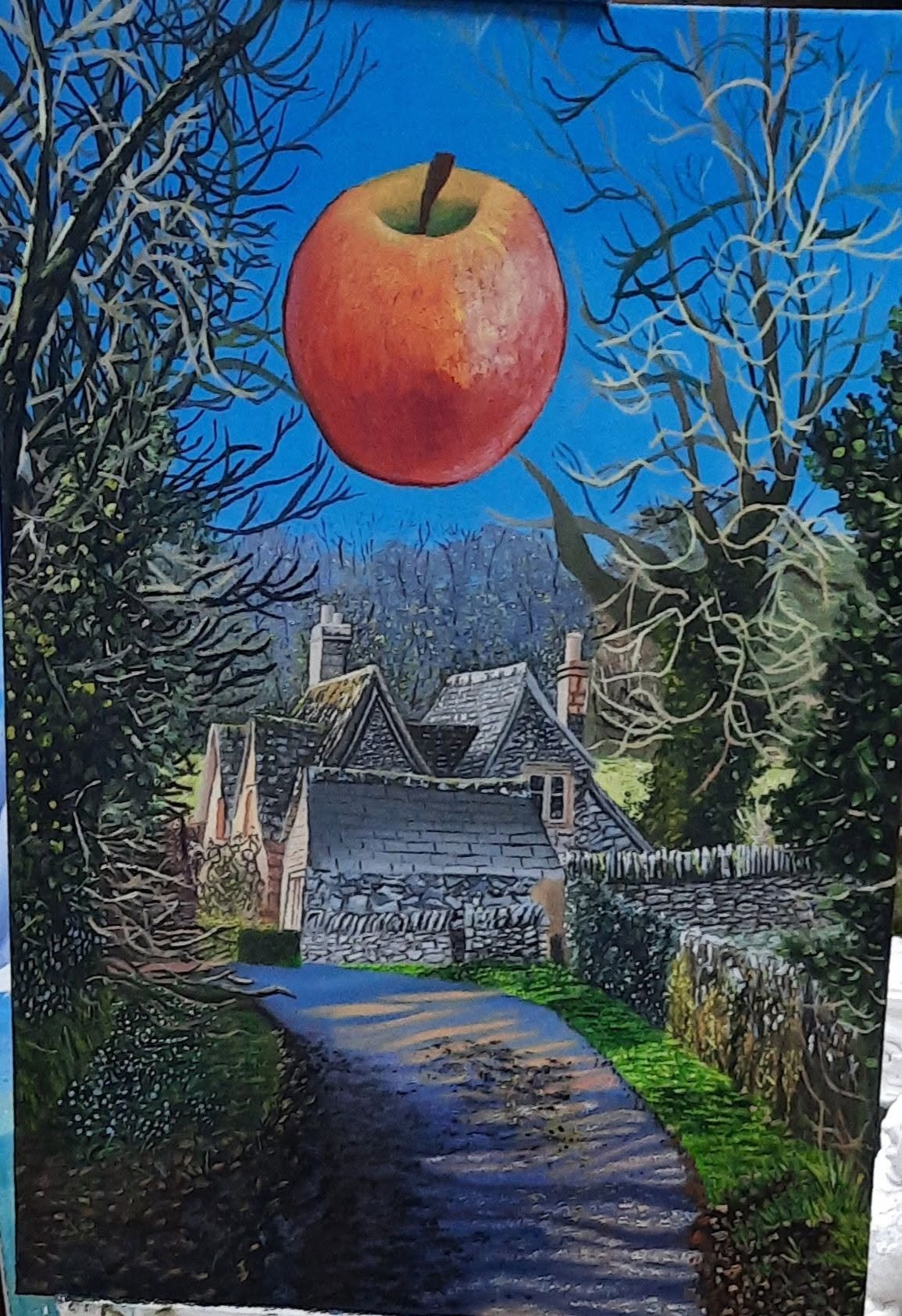
Gravity, painted in 2025, brings several of Day’s longstanding interests together. An apple rises into the sky above an English countryside associated with Isaac Newton, tying the image to the history of gravity itself while inverting its most basic law. Day has spoken about the personal weight this painting carries for him as an artist with autism, describing how he finds inspiration in figures such as Newton, not as an established diagnosis of Newton’s life but as a personal framework through which he understands his own creative perspective. He describes autism as something that brings real challenges alongside a different way of seeing, one capable of contributing something worthwhile. The phrase he returns to, standing on the shoulders of giants, functions here as more than borrowed wisdom; it becomes a way of situating his own work within a much longer history of people who thought differently and made something of it.
From the Flat Surface to the Built Scene
Since 2020, Day’s attention has turned increasingly toward sculpture and diorama making, a move away from the flat surface of painting and photography and toward physical, constructed scenes. For an artist whose paintings have always implied more space than the canvas allowed, this shift into three dimensions reads as a logical continuation rather than a break, a way of finally stepping into the worlds his earlier work only gestured toward.
A Career Still Finding New Forms
That continuation is visible in his current project, a series of dioramas depicting zombies on holiday, an idea that carries the same appetite for unlikely combinations that has defined his work from the beginning. Twenty-five years on from his earliest bright drawings, James Day’s practice has changed almost beyond recognition in technique and medium, yet it remains driven by the same underlying curiosity: a willingness to place the familiar and the strange side by side and see what meaning emerges between them.
Follow a 25-year practice in motion. See James Day’s latest photorealistic still lifes, zombie dioramas, and works-in-progress on Instagram at @thequirkypainter5.