

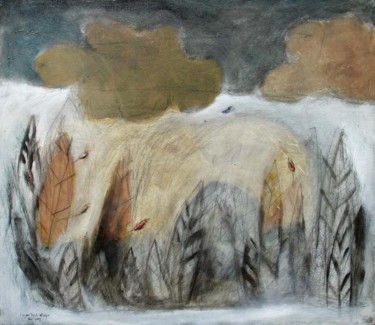
Painting has the unique ability to capture emotions, memories, and ideas through the language of color, texture, and composition. While some artists choose realism to communicate their vision, others find greater freedom in abstraction, allowing viewers to experience a work through personal interpretation rather than direct representation. Teguh belongs to this latter tradition, developing a contemporary painting practice that combines abstract forms with subtle references to landscapes. Working primarily with oil and acrylic on canvas, he creates compositions that invite reflection, emotion, and imaginative exploration.
At the center of Teguh’s artistic practice is a fascination with the expressive possibilities of painting itself. Rather than focusing solely on recognizable subjects, he explores how shapes, colors, and textures interact to create atmosphere and meaning. His paintings often exist in the space between abstraction and representation, where familiar elements emerge briefly before dissolving into expressive arrangements of form and color.
This balance between abstraction and landscape is one of the defining characteristics of his work. While some compositions suggest mountains, rivers, horizons, or natural scenery, these references are rarely presented as literal depictions. Instead, Teguh transforms the essence of a landscape into a visual experience, emphasizing mood and sensation over precise geographical detail. The result is artwork that encourages viewers to connect emotionally rather than simply observe.
Working with both oil and acrylic paint, Teguh takes advantage of the unique qualities each medium offers. Oil paint provides richness, depth, and subtle blending, allowing him to build luminous color relationships and gradual transitions across the canvas. Acrylic, by contrast, offers flexibility, vibrant color, and faster drying times, enabling spontaneous gestures and layered experimentation. By using these traditional materials thoughtfully, he achieves compositions that feel both technically refined and visually dynamic.
Texture plays an essential role throughout his paintings. Carefully layered brushstrokes, varied surface treatments, and contrasting applications of paint give each work a tactile quality that extends beyond its visual appearance. Light interacts differently with every textured area, revealing new details as viewers move around the painting. This physical dimension adds depth and complexity while reinforcing the emotional character of each composition.
Color serves as another fundamental element of Teguh’s artistic language. Rather than simply describing the visible world, his palette establishes atmosphere and emotional resonance. Soft earth tones may evoke calm and contemplation, while vibrant blues, reds, or warm ochres introduce movement and energy. Every color relationship contributes to the overall balance of the composition, creating visual harmony even within expressive abstraction.
His paintings frequently demonstrate a careful dialogue between structure and freedom. Some passages reveal deliberate organization through balanced forms and controlled geometry, while others embrace spontaneous gestures and organic movement. This contrast creates visual rhythm, allowing each canvas to feel both thoughtfully composed and naturally expressive. It is within this balance that Teguh’s artistic identity becomes most recognizable.
Although abstraction is central to his practice, Teguh never completely abandons the influence of the natural world. Landscapes continue to inspire his creative process, not as scenes to reproduce but as sources of atmosphere, light, and emotional memory. The changing colors of the sky, the movement of water, and the quiet presence of open spaces all find their way into his work through abstract visual language. These subtle references allow viewers to discover echoes of nature without limiting the artwork to a single interpretation.
One of the strengths of Teguh’s paintings is their openness. Rather than presenting fixed narratives or specific symbolic messages, his compositions invite viewers to bring their own experiences and emotions into the act of interpretation. A painting that suggests tranquility for one observer may evoke nostalgia or contemplation for another. This flexibility reflects the enduring power of abstract art to create deeply personal connections between artwork and audience.
His technical foundation is equally important. Mastery of traditional painting methods provides the confidence to experiment while maintaining visual coherence. Every layer of paint, every adjustment of color, and every compositional decision reflects a thoughtful understanding of balance and craftsmanship. Even in his most expressive works, there is an underlying sense of discipline that supports the freedom visible on the surface.
The relationship between form and space is another recurring theme within Teguh’s work. Rather than filling every area of the canvas equally, he carefully considers the interaction between positive and negative space. Open areas provide moments of calm, while denser passages introduce visual energy and complexity. This thoughtful arrangement encourages viewers to move through the composition naturally, discovering new relationships between colors and shapes over time.
As a contemporary painter, Teguh demonstrates that traditional materials remain remarkably relevant within modern artistic practice. Oil and acrylic continue to offer endless possibilities for innovation, especially when combined with an experimental approach to composition and abstraction. His paintings illustrate how classical techniques can support contemporary ideas without losing their expressive richness or technical sophistication.
The emotional atmosphere of his work is perhaps its most compelling quality. Rather than relying on dramatic imagery or explicit storytelling, Teguh creates paintings that communicate through subtle shifts in color, texture, and movement. These visual elements encourage quiet reflection, allowing viewers to slow down and engage with the artwork on an intuitive level. The experience becomes less about identifying subjects and more about responding to the feelings the paintings evoke.
Throughout his artistic journey, Teguh has remained committed to exploring the relationship between material, color, and form. Each new work represents another opportunity to refine this dialogue, expanding his visual language while remaining true to the principles that define his practice. His paintings reveal a continual search for harmony, where technical skill and creative freedom exist in equal measure.
Today, Teguh continues to contribute to contemporary painting through works that celebrate both abstraction and the enduring influence of nature. His expressive use of oil and acrylic, combined with a thoughtful exploration of texture and composition, has resulted in a body of work that is both visually engaging and emotionally resonant. By balancing atmosphere with structure and imagination with observation, he creates paintings that invite viewers to experience art as a space for reflection, interpretation, and discovery. Through this ongoing pursuit of balance, Teguh has established a distinctive artistic voice that continues to evolve within the landscape of contemporary art.