

When the Belarus Free Theatre opened “Official. Unofficial. Belarus.” at La Chiesa di San Giovanni Evangelista di Venezia earlier this month, it marked the first time Belarus had a presence at the Venice Biennale in six years and the first time it appeared there not as a state, but, as curator Daniella Kaliada put it, as “a self-governing, self-authored cultural body.”
The distinction matters enormously. Belarus has only appeared at the Biennale a handful of times, and not since President Alexander Lukashenko’s brutal crackdown on pro-democracy protesters in 2020. In exile since those protests, the Belarus Free Theatre has been at the forefront of efforts to counter the dictatorial Lukashenko regime and telling the country’s story on the international stage.
In Venice, the Theatre translates its approach to visual art, stepping away from the plays and theater productions that have become its calling card, to stage an exhibition featuring Belarusian artists working across painting, installations, and large-scale sculptures. The aim is to make the experience of living under authoritarianism viscerally legible—not just visible.
“We didn’t want visitors simply to learn about a situation,” cofounder Natalia Kaliada told in April. “We wanted them to pass through it: the architecture, feeling, sound, scent, sculpture, obstruction, surveillance, ritual, and bodily experience.”
The works on view draw on Belarus’s decades long experience of repression as both a specific history and a wider warning. As Kaliada said, what once read as a story from the periphery “can now be understood as a warning from the edge of a condition that is spreading.”
Below, see inside the exhibition and the artworks at its heart.
1
Daniella Kaliada and Natalia Kaliada, Surveillance Crucifix / Назіральнае Распяцце, 2026.

Daniella Kaliada and Natalia Kaliada, “Surveillance Crucifix / Назіральнае Распяцце,” 2026.
Photo : Courtesy Belarus Free Theatre/Photo Dasha Trofimova
Upon entering the 13th century church, viewers first encounter Surveillance Crucifix, a sculpture created by the Kaliadas. The image is blunt, but powerful: a cross constructed from CCTV cameras and railway tracks. Surveillance is a persistent theme in the exhibition, not just because of its associations with the Lukashenko regime. For Daniella Kaliada, who lives in London, considered the most surveilled city in the world outside of China, the camera has become one of the most ubiquitous symbols of contemporary life and governance.
“You know you’re being watched all the time, which might give you a sense of security,” Kaliada said of London. “And yet we have some of the highest knife crime rates, and perpetrators are rarely found. So I think audiences are now able to recognize this, across cultures. It changes how the work is read, but not what it is. Belarus is an entrance point into questioning: Is our surveillance the same? Are we all being watched—but being watched differently?”
2
Daniella Kaliada and Natalia Kaliada, Confessional of the System / Спаведальня Сістэмы, 2026

The blending of religious iconography and surveillance continues in the installation Confessional of the System, where the Kaliadas have turned the priest’s compartment into a surveillance center that both monitors the exhibition through various cameras. But the surveillance center simultaneously watches the watcher, analyzing their face for biometric markers in real time and producing data about one’s appearance, political status, and mental health. While the confessional booth looks sinister enough, one sits down in the booth, it is disarming to see yourself analyzed in much the same way that social media algorithms might, a harmlessness reinforced by an algorithm in the corner that offers your closest celebrity lookalike.
3
Nicolai Khalezin, Dogs of Europe/Сабакі Эўропы, 2026.

One of the only works not made specifically for the Venice exhibition is the sculpture Dogs of Europe, which was originally produced for the Theatre’s 2022-23 production of Dogs of Europe, a play adaption of a banned Belarusian dystopian novel. The sculpture depicts various books banned in Belarus, which is striking both the sheer volume of books banned, and also for the breadth. Amongst the banned are children’s literature that one hardly thinks of as dissident.
4
Several Works on View

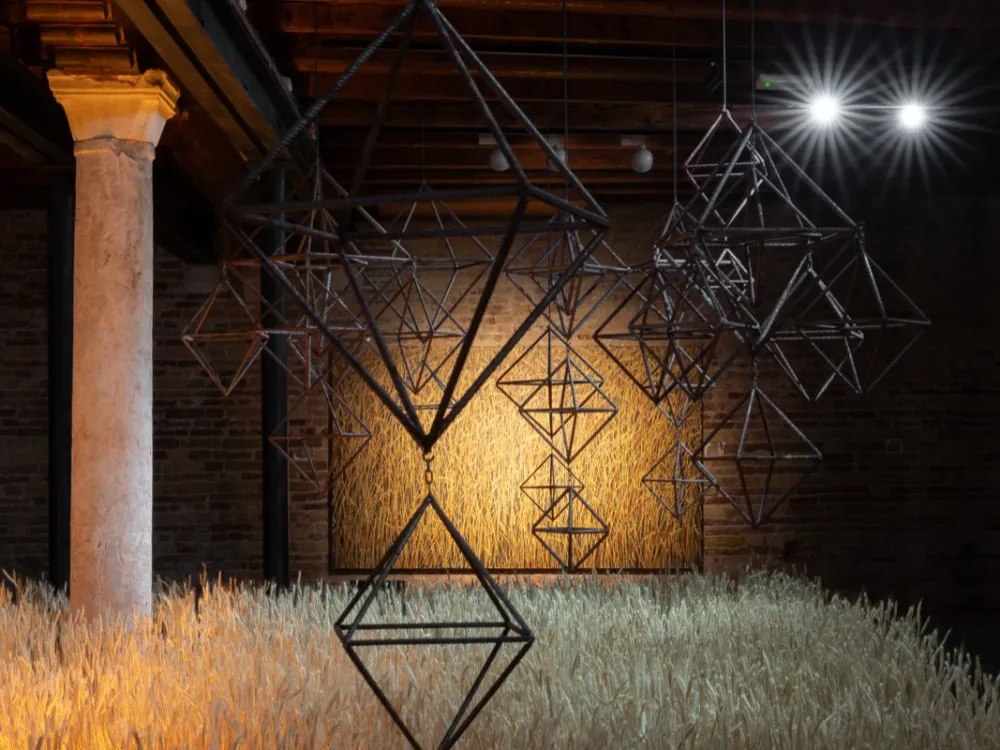
The exhibition takes multiple artistic strategies to convey the restrictiveness and imposed order of the Belarusian experience. A picture-perfect field of wheat, a staple crop in Belarus and a source of traditional craft, occupies a cemetery off the main apse of the church. Above it, Vladimir Tsesler has created metal sculptures that recall the folk art of pavouk, in which straw is used to craft hanging spiders. The wheat is set against its nature, to grow wild and irregular, while the straw spiders are now cast in inflexible metal, a temporary cultural practice made permanent.
5
Sergey Grinevich, “Obedience / Паслухмянасць,” 2026.

Throughout the exhibition, installations are placed that move beyond the visual. In the cemetery, and next to certain groupings of paintings, a sound installation recounts the experiences of Belarusian political prisoners, voiced by major actors like Jude Law and Gillian Anderson to protect their identities. An olfactory installation, activated by candles and designed by Ukrainian studio ol.factory, permeates the church with the smell of dirt and rotting flowers, meant to evoke a freshly dug grave.
6
Sergey Grinevich, Crucifixion I / Распяцце I, 2026

Throughout the exhibiiton, Grinevich, one of Belarus’s most famous artists, has created site-specific paintings of the crucifixion that are meant to recall, and subvert altar panels. Here again, the Theatre blends and conflates religious and authoritarian symbols.
7
Sergey Grinevich, Crucifixion / Распяцце, 2026
