

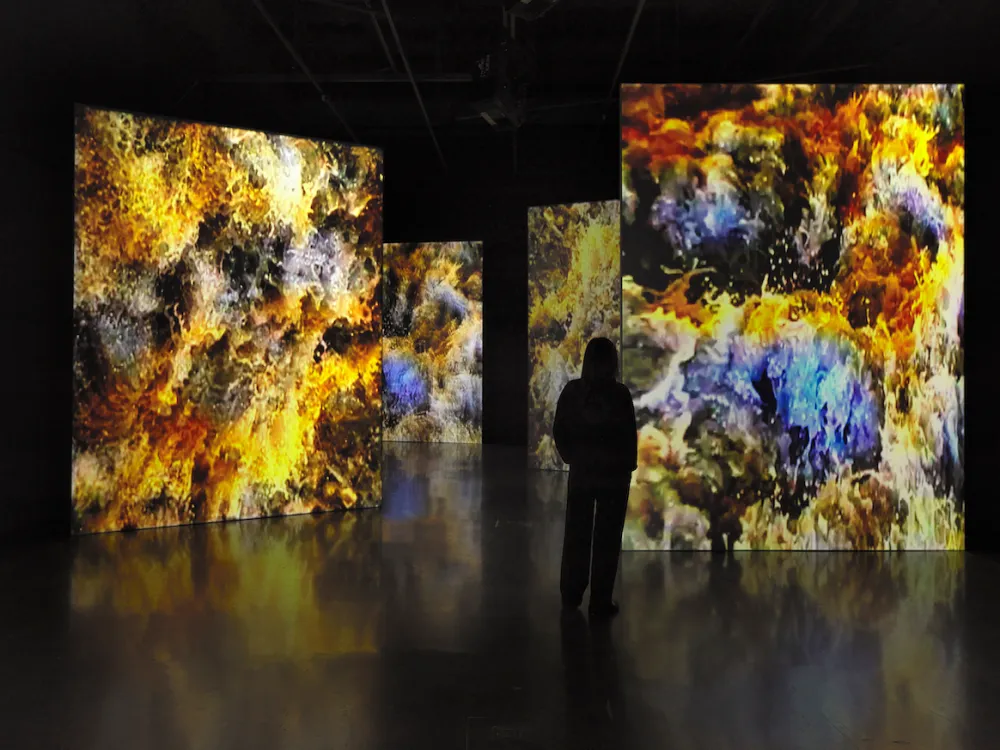
I can think of just one artist who has bragged about making her viewers throw up, and that artist is Steina, a giant of video art history whose survey at Cambridge’s MIT List Visual Arts Center is now in its final days. A friend of the artist viewed her 1993 installation Borealis and had to dart away as a result, feeling the sudden urge to vomit, Steina once recalled. The reasons why are obvious: Borealis, like many other works by Steina, utilizes video technology’s perception-altering possibilities to induce vertigo, confusion, and disorientation and a new way of seeing the world altogether.
Borealis, one of the 21 works in MIT’s fabulous show, is composed of several large screens that are projected with footage of the natural landscape in Iceland, Steina’s home country. The rock formations and splashes of water seen here are heavily manipulated, periodically dissolving into pixelated blurs as the camera pans across them in all directions. Walking amid these towering screens, one can feel the ground moving beneath one’s feet.
This installation may be the most extravagant work in the MIT show, titled “Steina: Playback” and elegantly curated by Natalie Bell. (In March, the show travels to the Buffalo AKG Art Museum, the Upstate New York city where Steina once lived, before making its way, in an expanded form, to two Icelandic museums.) But even the older, seemingly more lo-fi works on hand at MIT are just as disturbing to the eye. In tapes and installations form the ’70s, Steina uses synthesizers, computers, and more to cause her images to warp, strobe, and disassemble, effectively reordering what visual art can look like in real time.
None of this will be a revelation to video art enthusiasts, who have long worshipped at Steina’s feet. In her 2020 history of video art, curator Barbara London writes of artists making “pilgrimages” to Steina’s studio in Santa Fe, New Mexico, just to meet the artist. And that’s not to mention the fact that Steina and her late husband, the artist Woody Vasulka, founded the Kitchen, which remains the go-to art space for media and performance art in New York.

But even within the history of video art, Steina’s place isn’t entirely certain. She didn’t make it into “Signals,” a recent Museum of Modern Art survey of the medium, and she only gets a few lines in Michael Rush’s Video Art, the most widely read book devoted to this subject. Part of the reason for this is the nature Steina’s art of the ’70s, which is neither overtly political nor particularly concerned with the aesthetics of television, against which many early video artists defined themselves. Her MIT survey instead suggests she was after something altogether different, something more playful, more liberated.
Take the case of Violin Power (1970–78), in which Steina, a musician by training, can be seen playing Bach on the violin. The video then cuts to Steina lip synching to the ecstatic final verse of The Beatles’ “Let It Be,” her mouth shown in such an extreme close-up that you can see the spit glistening on her teeth. Then there’s more footage of Steina playing the violin, this time with various distortions. Her bow now appears to shiver into a double helix, and at one point, she melts away entirely into quaking soundwaves.
Why Bach? Why The Beatles? You don’t need to understand the internal logic to love Violin Power, which remains Steina’s most famous work for a reason. (Knowledge of the technology she employed isn’t necessary either, though the show’s thoughtful catalog acts as a useful companion.) Violin Power is entrancing because it uses video to induce new ways of seeing and hearing something you can’t claim for many other artworks made in recent history.
Steina approached video in a different way than most artists, perhaps because she wasn’t one to begin with. She was born in 1940 in the Icelandic capital of Reykjavík, and went on to study classical violin in Prague, the city where she met Woody Vasulka. By the time she and Vasulka moved to New York in 1965, she had already played as part of Iceland’s most important orchestra and worked as a freelance musician. Pop and Minimalism had planted the seeds of an artistic revolution in New York, but the MIT show doesn’t mention those movements or related ones, like Op and Conceptualism. Perhaps Steina had little interest in them at all.

It’s possible to draw similarities between Matrix I (1970–72), the earliest work at MIT and a collaboration with Vasulka, and some of these contemporaneous artistic tendencies. It’s composed of rows of TV monitors arranged into a grid (à la Minimalism) and displaying undulating black-and-white patterns that appear to vibrate (à la Op). But Steina’s work moves it is not a static painting hanging on a wall or a gargantuan sculpture set within the middle of the gallery and it’s all possible because of electronic signals.
In 1974, Steina departed New York for Buffalo and became a part of the latter city’s rich experimental media scene. She produced works such as Allvision (1976), an installation in which two cameras orbit a reflective sphere, relaying their feeds to televisions mounted all around. If you were to look into this gazing ball, you’d just see yourself staring back. The feeds, however, display the cameras’ reflected lenses and the whole room simultaneously more than the human eye could ever take in at once.

Allvision seems at first to have something in common with early video experiments that used delays and live feeds to explore split consciousnesses. Yet those formalist artworks demanded the theoretical rhetoric associated with October and other high-minded art journals you needed to have a working knowledge of psychoanalysis, structuralist filmmaking, and Conceptual art to understand tapes by Joan Jonas, Lynda Benglis, and the like. (Or, at least so went the common line of thinking at the time.) Steina’s art doesn’t require so much knowledge to enjoy it, and that is both its charm and its curse.

In Summer Salt (1982), a videotape made after Steina and Vasulka’s relocation to Santa Fe, her camera is placed in a glass tube attached to a convex mirror and brought to the open expanses around the New Mexican city. Addictive as it may be to watch blades of grass, cloudy skies, and trees twist into abstraction, the video feels like it doesn’t have much in the way of conceptual heft. Sure, it offers a lot for the eye to take in, but it doesn’t have quite enough for the brain to mull over. That’s not always such a bad thing, of course, but I sometimes found myself wondering if certain pieces here contained much of anything beneath their striking surfaces.
Still, there’s no question that Steina’s technical tinkering is enchanting. Her room filling video installation Mynd (2001) features footage of horses that blur, expand, and contract, as though their bodies were made of rubber. Steina made the work using a program she developed called Image/ine, which allows its user to manipulate images on the spot, without having to go home and edit footage in post-production. The title translates from Icelandic to “image,” yet it seems like no coincidence that it reads like a different word in English. This piece is both mynd-altering and mind altering.