

Flowers have been asked to carry meaning for as long as artists have painted them. They stand for brevity, for desire, for renewal, for the moment before decay. Photographers inherit that vocabulary whether they want it or not. Karel Fehr’s Raising Head works with it deliberately, and with an unusually economical set of signs: a pale bud, a dark ground and a scattering of water.
First Reading: Emergence
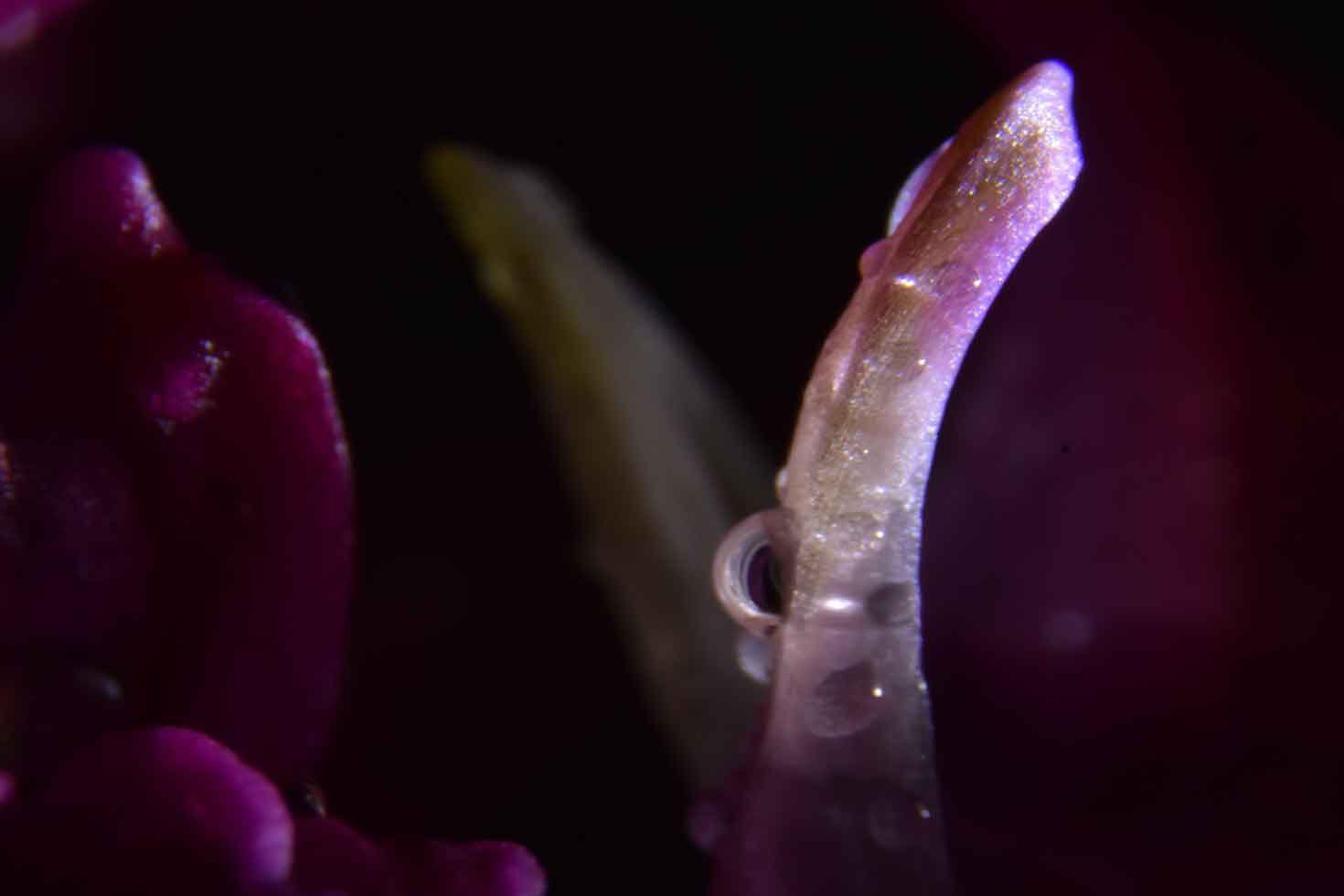
The image divides into two zones. At the left, deep magenta and purple petals mass together, heavy and mostly shadowed. At the right, a pale, translucent form lifts out of them, upright and slightly curved, with droplets clinging to its surface. Behind everything, the ground is nearly black.
The official description reads the scene as a floral awakening, a form gently unfurling against the darkness, with purple hues suggesting a regal and mysterious life force stirring from slumber. The title supports it. A head that is being raised implies a head that was lowered, and so the picture is about a change of state rather than a fixed condition. The bud is not simply there. It is on its way somewhere.
Emergence is among the oldest of floral symbols, and photographic art has returned to it often. What is notable here is how little the image does to dramatise it. There is no burst of light, no theatrical gesture. The rising is conveyed by a slight verticality and a difference in tone, which gives the moment a convincing modesty.
Second Reading: Darkness and Illumination
The ground of the picture matters as much as the flower. Dark backgrounds have a long history in floral painting, most famously in the still lifes of the Dutch Golden Age, where blossoms glow against black and beads of water sit on petals. The comparison is a point of resemblance rather than influence, but it clarifies what Fehr is doing. The darkness is not emptiness. It is a stage on which light can be seen at work.
In Raising Head, the light is minimal and decisive. It falls on the pale bud, picks out its translucence, and leaves the magenta petals to sink into shade. The relationship is not a battle between dark and light but a negotiation. The dark gives the bud something to emerge from, and the light gives the dark something to surround. Neither would be legible alone.
The purple range deserves its own note. Purple has long carried associations with royalty and mystery, which is what the official reading picks up, but in the photograph it also does optical work. Dark purple sinks into shadow without turning black, so the petals keep a sense of depth even in the dimmest passages, while the pale bud, near cream, stands out by contrast.
Third Reading: The Droplets
The water is the smallest element in the picture and perhaps the most telling. The official text notes that the droplets add a layer of intimacy and immediacy, and the observation is exact. Droplets are fleeting and tangible. They tell us that the moment is recent, that dew or rain has just visited, and they give the viewer a sense of standing near enough to touch.
They also work symbolically. In the older tradition of flower painting, water on petals was a reminder of brevity, of how quickly freshness passes. Here the droplets contribute the same note quietly. The bud is rising, but the beads of water suggest that the moment of rising is already slipping away. Transformation and transience arrive together, which is perhaps the most honest way to describe any beginning.
Reading the Image Within the Practice
It is worth asking how the picture sits within the rest of Karel Fehr’s work. His website describes a commercial career of more than four decades, followed by a turn toward photographic art at the point of his retirement, with abstraction and conceptual imagery among the directions he has taken. The gallery text speaks of intimate natural details enlarged until they become striking forms.
Raising Head fits that description while adding a symbolic layer. It is less abstract than some of the gallery’s colour studies, and it leans toward the narrative: a story of waking, in miniature. Yet it keeps the central discipline of the collection, which is to let a small, unnoticed thing stand for something larger.
There is also the matter of attention. A dark-ground flower picture teaches the viewer to wait, because detail emerges slowly from shadow. That slow unveiling is itself a small version of the emergence the image depicts.
A Closing Interpretation
Interpretation should be offered as interpretation, and the readings above are one viewer’s. The documented facts are simple: a floral subject, a dark ground, droplets, purple tones, an official reading in terms of awakening. What the picture does with them is to compress a familiar drama, emerging from obscurity into light, into a frame small enough to hold in one glance.
The compression is the achievement. The picture does not argue for emergence or illustrate it. It stages it, using the oldest tools available to a flower photographer, and trusts that the viewer already knows what a rising head, in the dark and wet with recent water, might mean.
Further floral works can be found at karelfehr.com.