

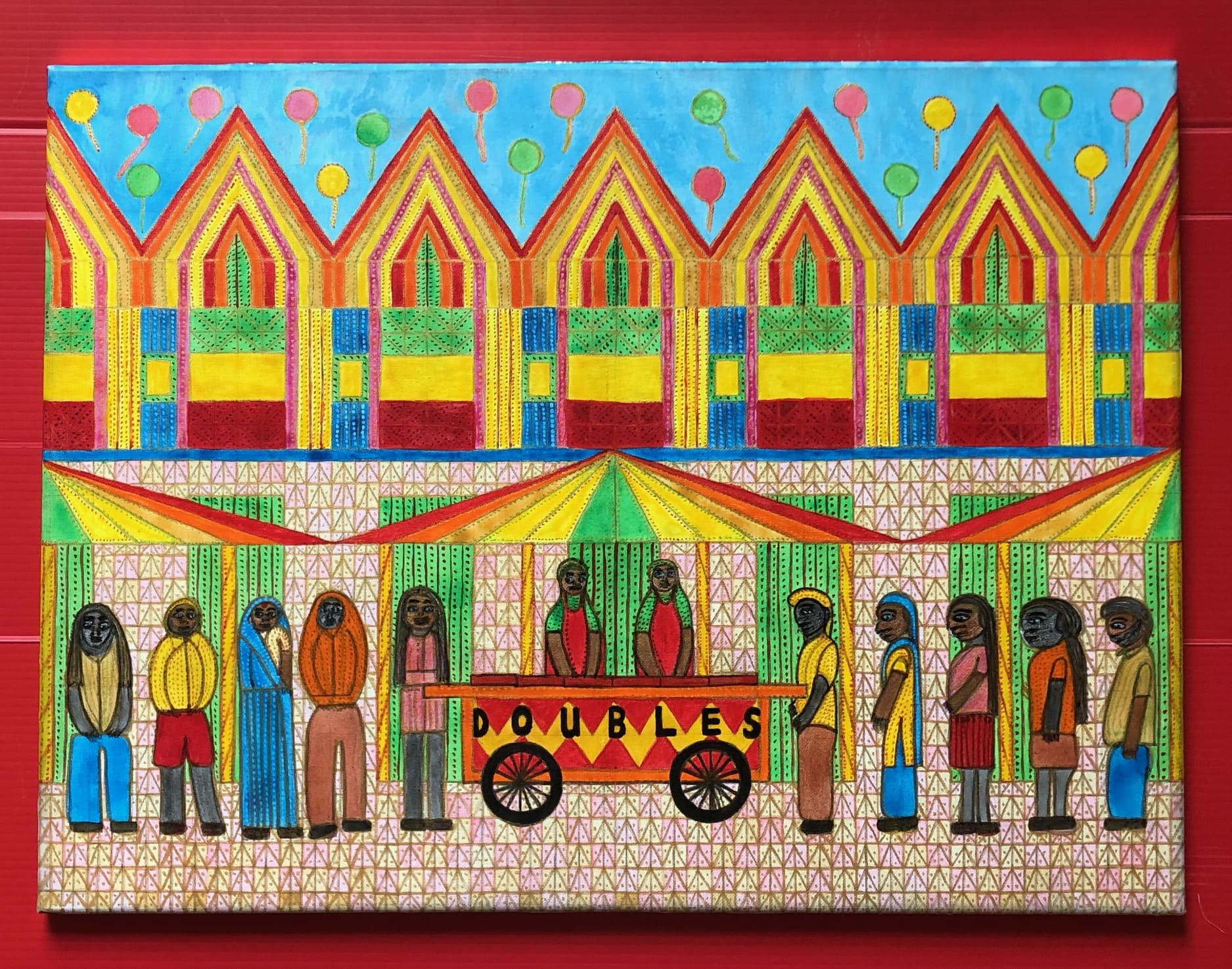
Long before Indra Persad Milowe picked up a brush with any real seriousness, she was already collecting material for her life’s work, though she wouldn’t have called it that at the time. Growing up in Trinidad and Tobago during the 1950s and 1960s, she was simply living: hearing steelpan drift through the air, watching limbo dancers bend beneath flaming torches, smelling curried chickpeas frying at a roadside stand. These weren’t yet subjects. They were just Tuesday.
Decades later, living in Salem, Massachusetts, those ordinary moments became the raw material of an artistic career that would eventually stretch from the Caribbean to Bali, Morocco, and Singapore. What makes Indra’s story compelling isn’t just where her work has traveled, but where it started: in memory, in the specific and unglamorous details of daily life on the islands, the kind of details that only become precious once you’ve left them behind.
A Vendor, a Recipe, and the Story Behind “The Doubles Vendor”
There’s a particular kind of homesickness that doesn’t ache so much as it accumulates, quietly, over years. For Indra, that accumulation found an outlet in paint. Her paintings aren’t nostalgic in a soft-focus, sentimental sense. They’re precise. They remember specific instruments, specific foods, specific rituals, and they insist on getting the details right.
Take The Doubles Vendor. To someone unfamiliar with Trinidad and Tobago, it might read simply as a street food scene. But doubles carry real history: the dish was created in 1936 in Princes Town by Emamool “Mamoodeen” Deen and his wife, Raheeman Rasulan Deen, who began by selling curried chickpeas with a single piece of fried flatbread, called bara. When customers started asking for two, the dish, and its name, was born. Doubles reflect the Indo-Trinidadian communities who shaped so much of the islands’ food culture, and they’re typically served with an array of condiments, pepper sauce, kuchela, tamarind chutney, green mango, each adding its own note. Indra’s painting isn’t just about food. It’s about the vendor, the customer, the transaction, the small daily ritual that ties a community together.
On Maracas Beach: Reading “All Women Steelpan with a Limbo Dancer”
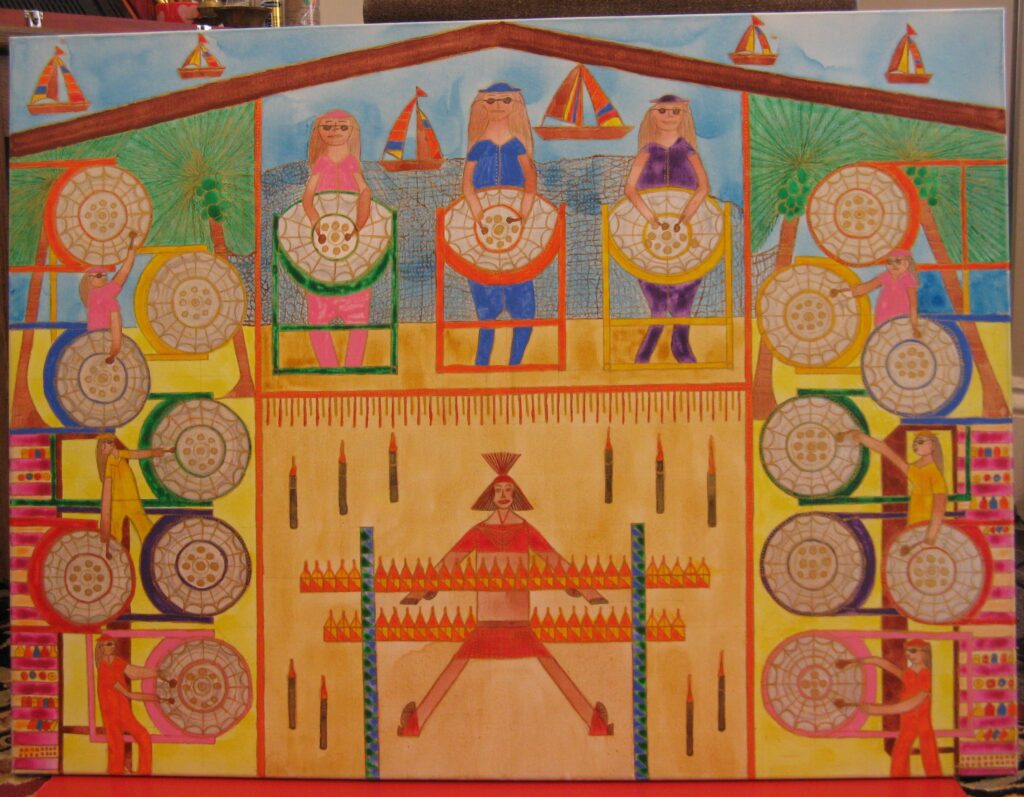
If food is one language of memory, music is another, and few instruments carry as much weight in Trinidadian identity as steelpan. Invented in Trinidad and Tobago and developed into its modern form largely through the work of Ellie Mannette, steelpan is a genuinely homegrown art form, one that has grown into full orchestral ensembles playing everything from soprano to bass.
Indra’s All Women Steelpan with a Limbo Dancer on Maracas Beach, Trinidad, West Indies brings this world to life, and the choice to center an all-women steelpan group is notable. Pan has historically been a male-dominated space, and the growing presence of women within it reflects a broader shift that musicians like Ronica Gordon have spoken about, one that includes calls for greater international recognition and support for pan musicians throughout their careers. Add to this the limbo dancer, surrounded by flaming flambeau torches, and the painting becomes a kind of composite portrait of Trinidadian performance culture: music, dance, spectacle, and community, all sharing a single beach.
A Quieter Register: The “Tulsi Mural” at Tulsi Studio & Gallery
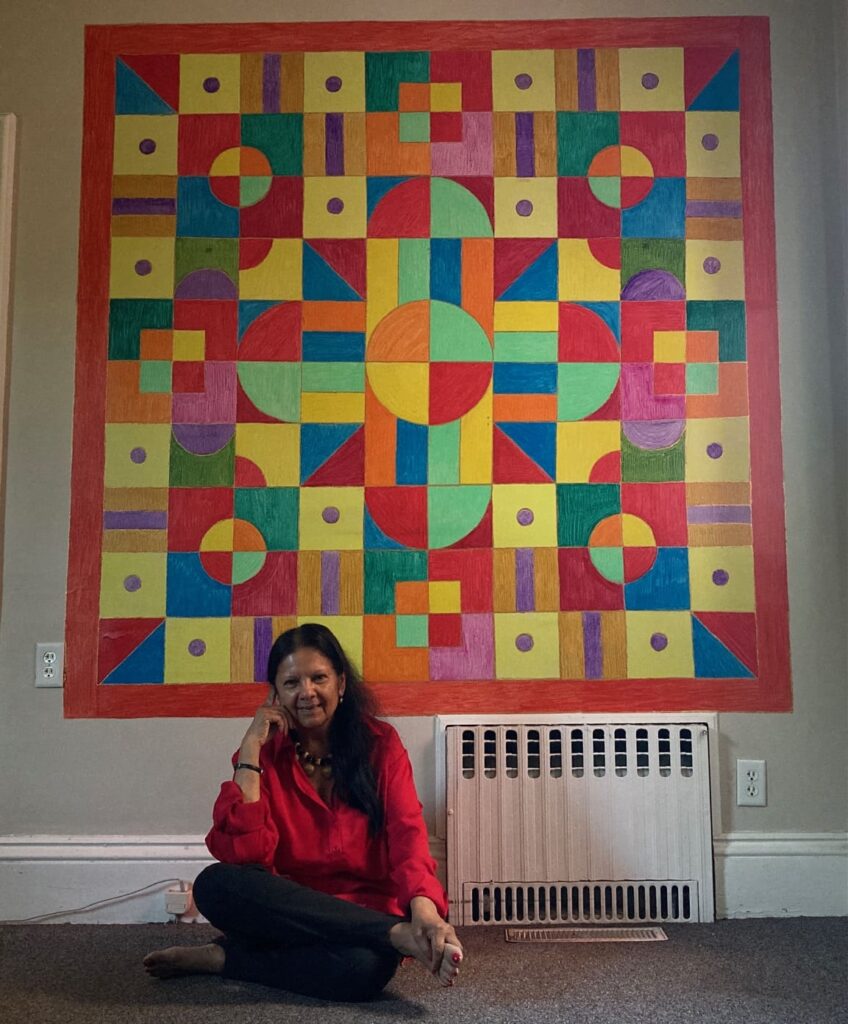
Not everything Indra paints is meant to be loud. Her Tulsi Mural, created at Tulsi Studio & Gallery, moves in a quieter direction. Tulsi, or holy basil, is a sacred plant within Hindu tradition, associated with purity and spiritual practice, and traditionally grown near homes as part of daily worship. Its ties to Lakshmi and Vishnu, and its role in Ayurveda, give it a significance that extends well beyond the garden.
Painting something sacred requires a different kind of attention than painting a beach scene or a food cart, and the mural reflects that shift in register. It’s a reminder that Indra’s relationship to Trinidad and Tobago isn’t only about festivity and celebration. It’s also about reverence, about the quieter traditions that shape a culture just as powerfully as its loudest ones.
Following the Work Outward
Indra’s cultural curiosity didn’t stop at the shores of Trinidad and Tobago. Her collections Beautiful Ubud, Bali and My Journey to Morocco reveal an artist who treats travel as a form of research. During an Artist-in-Residence experience in Ubud, she immersed herself in local ceremonies and festivals, absorbing new visual traditions rather than simply observing them from a distance.
That immersive approach has carried her work into some notable spaces: the Rotunda Gallery in the Red House, Port of Spain; Art Impact International in Washington, D.C.; and, in 2023, a Fine Arts Conference in Singapore, where she participated in an international gathering focused on the visual arts.
Building a Home for Public Art in Salem
Alongside this international exhibition history, Indra has put down real roots in Salem, contributing murals and public art that have earned her two grants from the city’s Public Art Commission. It’s a fitting development for an artist whose entire practice is built around the idea that culture belongs in shared, visible spaces, not locked away in private collections. Salem’s own history of public memory-keeping makes it an unexpectedly natural home for this work.
Why the Work Keeps Finding an Audience
What ties all of this together, the steelpan, the doubles vendor, the tulsi plant, the murals in Salem, is a consistent instinct: preserve first, then share. Indra Persad Milowe didn’t set out to become an ambassador for Trinidad and Tobago’s culture; she set out to remember it accurately, and in doing so, she built a body of work that resonates with people who have never been near the Caribbean.
That’s likely why her paintings continue to connect internationally. They don’t ask viewers to already understand Trinidadian culture. They invite them in, one steelpan performance, one street food cart, one sacred plant at a time, and trust that specificity, rendered honestly, is its own form of universal language.
Explore more of Indra Persad Milowe’s artwork, artistic journey, and cultural storytelling at IndraPersadMilowe.com